Heavy Industrial Maintenance Services: Improving Plant Reliability and Equipment Performance
In today’s competitive industrial environment, maintaining reliable equipment and ensuring consistent production are essential for business success. Manufacturing plants, oil and gas facilities, power generation stations, mining operations, and other heavy industrial facilities depend on high-performing machinery to maintain productivity, control operational costs, and meet production targets.
Heavy industrial maintenance services play a critical role in achieving these objectives. Through preventive maintenance, equipment inspections, timely repairs, and performance optimization, industrial businesses can minimize unexpected breakdowns, extend machinery lifespan, and improve overall plant reliability.
What Are Heavy Industrial Maintenance Services?
Heavy industrial maintenance services involve the inspection, servicing, repair, and optimization of large-scale machinery, industrial equipment, and plant infrastructure. These services help ensure that critical equipment operates safely, efficiently, and reliably under demanding working conditions.
Industrial maintenance professionals work with equipment such as pumps, compressors, turbines, conveyors, industrial motors, hydraulic systems, processing machinery, and other essential plant components.
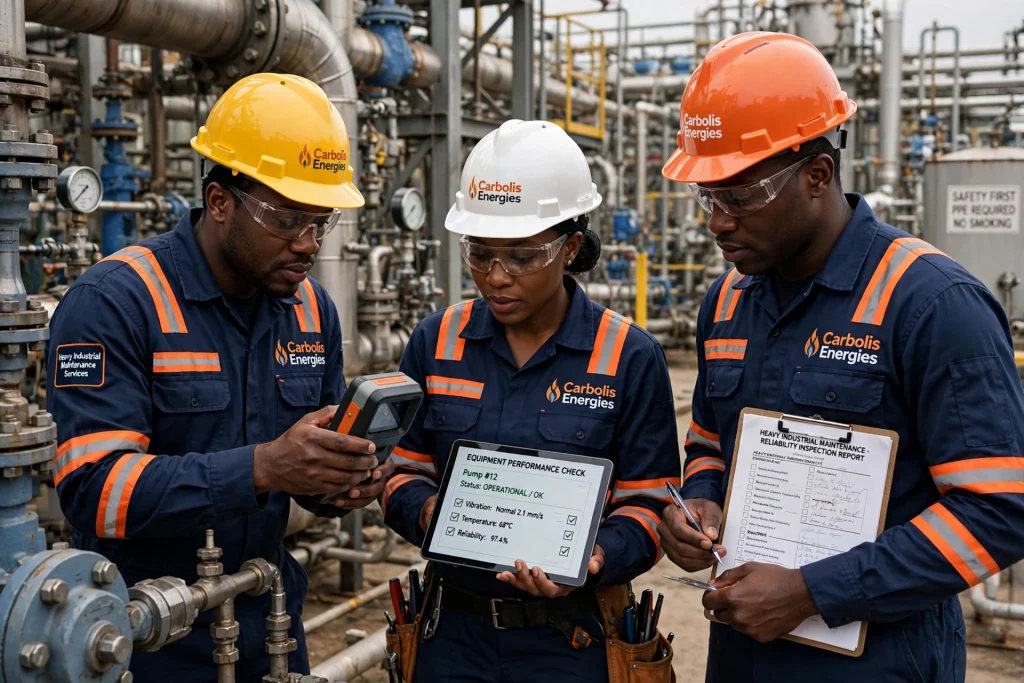
Depending on the facility’s needs, maintenance services may include mechanical repairs, equipment overhauls, alignment, lubrication, vibration analysis, condition monitoring, and scheduled preventive maintenance.
Why Plant Reliability Matters in Heavy Industry
Plant reliability directly affects production output, operating expenses, workplace safety, and customer satisfaction. When critical equipment fails unexpectedly, businesses may experience production delays, expensive emergency repairs, damaged components, and missed delivery deadlines.
A reliable maintenance strategy helps industrial facilities identify potential problems before they develop into major failures.
By investing in professional industrial plant maintenance, businesses can improve equipment availability, reduce production interruptions, manage maintenance budgets more effectively, and maintain consistent operational performance.
5 Ways Heavy Industrial Maintenance Services Improve Equipment Performance
1. Preventing Unexpected Equipment Breakdowns
Unexpected machinery failure can disrupt entire production processes. Preventive maintenance helps reduce this risk by identifying wear, leaks, overheating, vibration, and other warning signs before equipment failure occurs.
Scheduled inspections, lubrication, component replacement, and equipment servicing help maintain machinery in suitable operating condition.
With a structured maintenance program, businesses can plan repairs around production schedules instead of responding to costly emergencies.
2. Extending Equipment Lifespan
Industrial equipment represents a significant capital investment. Replacing heavy machinery prematurely can increase operational expenses and affect long-term profitability.
Regular servicing helps reduce excessive friction, component wear, overheating, and mechanical stress. Proper alignment, lubrication, cleaning, and timely replacement of worn parts can help extend equipment service life.
Professional heavy equipment maintenance services allow businesses to protect valuable assets while improving long-term maintenance planning.
3. Improving Operational Efficiency
Poorly maintained machinery often consumes more energy, produces inconsistent output, and operates below its intended performance level.
Industrial maintenance specialists can identify mechanical inefficiencies, inspect critical components, correct alignment problems, and recommend appropriate equipment improvements.
These activities can support smoother production processes, improved energy efficiency, reduced material waste, and more consistent product quality.
4. Enhancing Workplace Safety
Equipment failures can create serious safety risks, particularly in environments involving high temperatures, heavy loads, rotating machinery, pressurized systems, and hazardous materials.
Regular maintenance helps identify defective components, damaged guards, fluid leaks, and other potentially dangerous conditions.
A well-managed maintenance program should include appropriate risk assessments, lockout/tagout procedures where applicable, equipment testing, and compliance with relevant safety requirements.
Maintaining equipment in safe working condition helps protect workers, contractors, plant assets, and the surrounding environment.
5. Reducing Maintenance and Operating Costs
Emergency repairs can be more expensive than planned maintenance because they may require urgent labor, expedited spare parts, and unplanned production shutdowns.
A preventive or condition-based maintenance strategy helps businesses prioritize repairs, manage spare-parts inventory, and allocate maintenance resources more efficiently.
Over time, better maintenance planning can reduce avoidable downtime and help control the total cost of equipment ownership.
Types of Industrial Maintenance Services
Choosing the right maintenance approach depends on the type of equipment, operating environment, production requirements, and consequences of equipment failure.
Preventive maintenance: Scheduled servicing and inspections designed to reduce the likelihood of equipment failure.
Predictive maintenance: Using condition-monitoring techniques, such as vibration analysis, thermography, and oil analysis, to identify developing faults and estimate when intervention may be needed.
Corrective maintenance: Repairing defects discovered during inspections or operation to restore equipment to its required condition.
Mechanical maintenance and overhaul: Inspecting, repairing, refurbishing, or replacing mechanical components to restore equipment performance.
Reliability-centered maintenance: Selecting maintenance tasks based on equipment function, failure modes, operational risks, and business priorities.
Combining these approaches can help industrial facilities develop a maintenance program suited to their operational needs.
The Role of Technology in Modern Industrial Maintenance
Modern industrial maintenance increasingly relies on technology to improve fault detection and support informed decision-making.
Condition-monitoring sensors, computerized maintenance management systems (CMMS), equipment performance data, and predictive analytics can help maintenance teams track asset conditions, schedule work, document repairs, and identify recurring problems.
These tools support a more proactive approach to plant maintenance by helping teams focus on equipment that presents the greatest operational risk.
However, technology works best when combined with qualified technicians, accurate maintenance records, suitable procedures, and consistent management oversight.
How to Choose the Right Industrial Maintenance Contractor
Selecting an experienced industrial maintenance contractor is an important decision for any plant operator. The right service provider should understand the facility’s equipment, operating conditions, safety requirements, and production objectives.
Consider the following factors when evaluating a maintenance partner:
- Technical expertise: Look for relevant experience with your machinery, industry, and maintenance requirements.
- Safety standards: Confirm that the contractor follows applicable workplace safety procedures and regulatory requirements.
- Service reliability: Evaluate its ability to plan maintenance activities, respond to urgent issues, and communicate effectively.
- Maintenance planning: Choose a provider that supports preventive maintenance, condition monitoring, and accurate service documentation.
- Quality assurance: Ask about inspection procedures, repair standards, testing, and maintenance reports.
- Long-term value: Assess the provider’s ability to improve equipment reliability and control lifecycle costs, rather than focusing only on the initial service price.
A qualified maintenance partner can help businesses establish a practical maintenance strategy aligned with production goals and equipment reliability targets.
Key Performance Indicators for Measuring Maintenance Success
Industrial facilities should measure maintenance performance to understand whether their maintenance strategy is delivering results.
Useful key performance indicators (KPIs) include:
- Mean time between failures (MTBF): Measures the average operating time between equipment failures.
- Mean time to repair (MTTR): Tracks the average time required to restore equipment after a failure.
- Equipment availability: Measures the proportion of time equipment is available for operation.
- Unplanned downtime: Tracks production time lost because of unexpected equipment problems.
- Preventive maintenance compliance: Measures how consistently scheduled maintenance tasks are completed.
- Maintenance cost per asset: Helps monitor spending and identify opportunities for improvement.
Tracking these indicators over time allows plant managers to identify recurring issues, assess maintenance effectiveness, and make better-informed operational decisions.
Conclusion: Build a More Reliable and Efficient Industrial Plant
Heavy industrial maintenance services are essential for businesses that depend on reliable machinery and uninterrupted production. From preventive maintenance and mechanical repairs to predictive monitoring and equipment overhauls, a structured maintenance strategy can help reduce unexpected downtime, improve operational efficiency, enhance workplace safety, and extend equipment lifespan.
By investing in skilled maintenance personnel, appropriate technologies, and proactive maintenance planning, industrial facilities can strengthen plant reliability and improve long-term equipment performance.
Looking to improve your plant’s reliability and equipment performance? Partner with an experienced industrial maintenance service provider to assess your equipment, identify maintenance priorities, and develop a strategy that supports safe, efficient, and dependable operations.